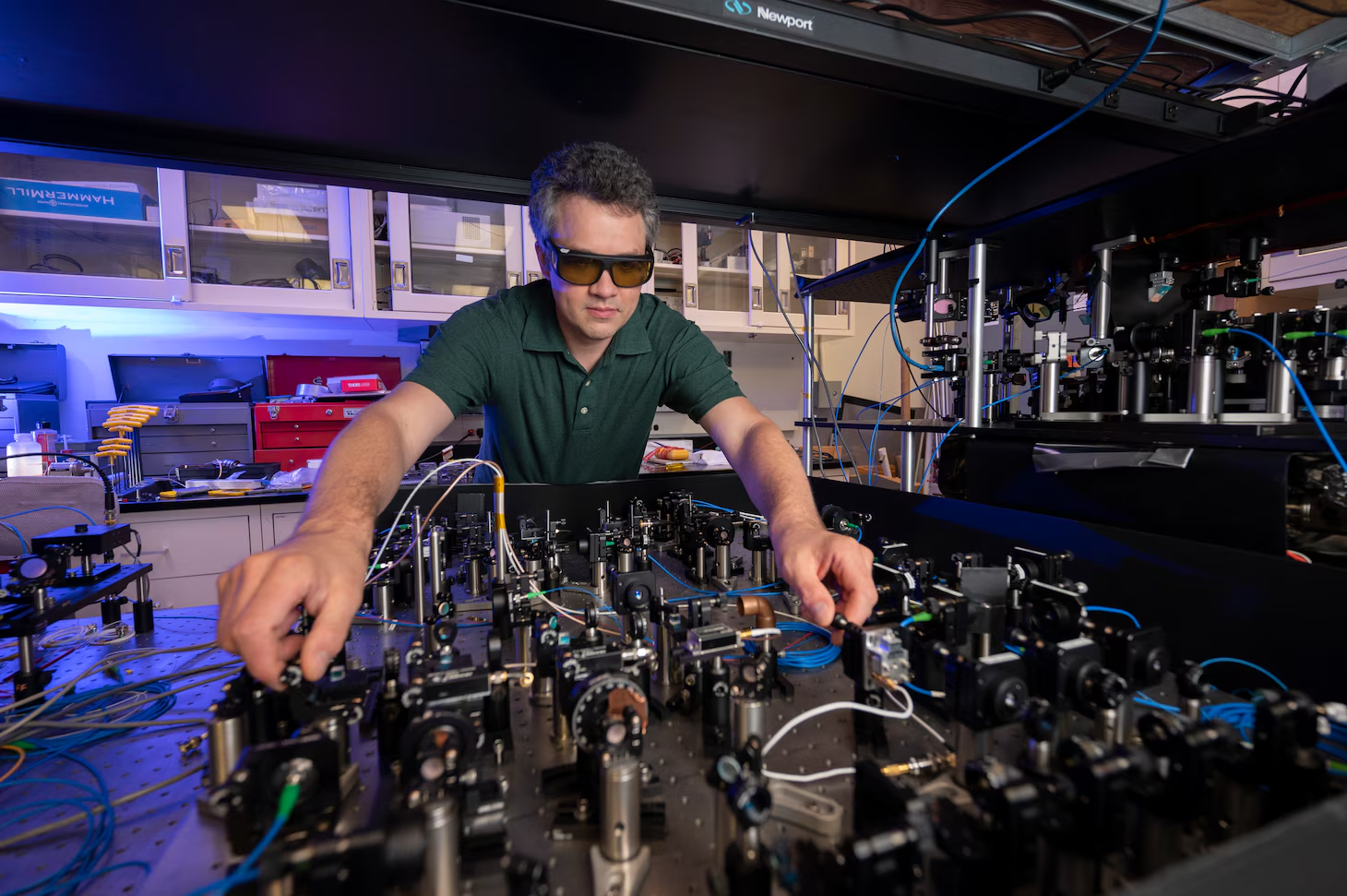
The U.S. Naval Research Laboratory is unifying its quantum research efforts as the nation prepares for what a recent Executive Order calls “the cusp of a quantum revolution.” Adam Black, Ph. D., directs the newly-formed Quantum Science Institute at NRL, coordinating quantum research across the entire laboratory to develop technologies for navigation, sensing, secure communications and computing.
“The institute encourages collaboration across the laboratory and creates a central organization for partnerships with industry and other government organizations,” Black said, emphasizing the need to leverage rapidly advancing quantum computing technology. This centralized approach reinforces the national priority of maintaining a strategic technical advantage in quantum information science and technology.
Quantum Science Institute Coordinates Navy’s QIST Research
The U.S. Naval Research Laboratory (NRL) has formally unified its quantum research under the Quantum Science Institute, a move signaling a significant escalation in the Navy’s commitment to quantum information science and technology (QIST). Established on June 13, 2025, the Institute serves as the Navy’s primary QIST research center, consolidating decades of expertise previously distributed across the laboratory. Adam Black, Ph. D., the director, emphasizes a collaborative approach and actively prepares for advancements occurring in the private sector.
“Right now, we’re seeing rapid advancement in quantum computing technology in the private sector. It’s very important that we are able to take advantage of this technology,” Black explained. While industry leads in quantum computer construction, NRL is prioritizing the development of algorithms and applications tailored to Navy needs, tackling problems beyond the reach of conventional computers.
Researchers are also actively participating in initiatives like the Washington Metropolitan Quantum Network Research Consortium, or DC-QNet, to advance quantum networking research and secure communications. The Institute aims to translate fundamental scientific breakthroughs into tangible capabilities for the warfighter.
Right now, in the private sector, we’re seeing this very rapid advancement in quantum computing technology. It’s very important that we are able to take advantage of this technology.
Quantum Sensing Enhances Naval Navigation & Timing
Beyond quantum computing, the U.S. Naval Research Laboratory (NRL) is actively developing quantum sensors that could redefine naval navigation and timing capabilities. These technologies leverage the unique properties of quantum mechanics to achieve measurement precision exceeding that of conventional systems, which is crucial in environments where GPS signals are unavailable or unreliable. NRL’s focus extends beyond simply improving existing technologies; researchers are building entirely new methods for determining position and orientation.
One key area of development centers on atomic clocks, already vital for synchronizing critical systems, and extending that precision into new sensor types. Scientists are currently experimenting with ultra-cold rubidium atoms, chilled to near absolute zero, to measure acceleration and rotation with greater accuracy. This work aims to reduce navigation drift during prolonged naval operations, offering a significant advantage in contested environments. “Our research ranges from basic science through applied technology,” explains Adam Black, Ph. D., director of NRL’s Quantum Science Institute.
These quantum sensors encompass accelerometers, gyroscopes, gravimeters, and magnetometers, all designed to provide independent navigation solutions.
We conduct our own experimental and theoretical research while also supporting Navy and Department of Defense programs through technical expertise, experimental validation, modeling, analysis and strategy. For scientists, it’s a rare opportunity to help define an emerging technological era” NRL organizes its quantum research into four primary areas, closely aligning with national priorities identified in the Executive Order: quantum sensing, positioning, navigation and timing; quantum computing; quantum networking; and foundational science and enabling technologies.
While much attention focuses on building quantum computers, the U.S. Naval Research Laboratory (NRL) is charting a distinct course, prioritizing the algorithms and applications that will unlock their potential for naval operations. NRL’s approach differs from industry’s hardware focus, instead concentrating on software solutions tailored to specific naval challenges. Scientists are developing quantum algorithms designed to optimize logistics, model advanced materials, and improve predictions in areas like fluid dynamics and weather forecasting.
The laboratory’s efforts are organized around four core areas—sensing, computing, networking, and foundational science—all aligned with national priorities. This includes translating quantum principles into technologies supporting future missions, and conducting both theoretical and experimental research. The institute actively fosters collaboration with industry partners and other government organizations, ensuring a robust ecosystem for quantum innovation and a pathway for translating research into operational capabilities.
The institute encourages collaboration across the laboratory, and creates a central organization for partnerships with universities, industry and other government organizations.
Adam Black, Ph.D., director of NRL’s Quantum Science Institute
Advancing Quantum Networking & Foundational Technologies
Beyond the effort to build more powerful quantum computers, the U.S. Naval Research Laboratory is concentrating on the essential infrastructure needed to connect and support these future machines. A key component of this effort is the newly established Quantum Science Institute, directed by Adam Black, Ph. D., which coordinates quantum research across the entire laboratory, signifying a broad commitment extending beyond isolated projects. NRL’s focus extends to quantum networking, specifically exploring technologies to transmit quantum information securely.
Researchers are investigating methods to bolster communications security and enable future quantum computing architectures, recognizing that robust networks are vital for realizing the full potential of quantum computation. Underpinning these advancements is a dedicated effort to develop foundational technologies. NRL researchers are creating new quantum materials and integrated photonic devices, essential building blocks for future quantum systems.
This work isn’t solely theoretical; it’s driven by practical naval applications. “One of the exciting things about working at NRL is finding the intersection between cutting-edge basic science and the real operational needs of the Navy,” Black explained. This intersection ensures research translates into tangible improvements for future naval operations, from secure communications to enhanced sensing capabilities.
One of the exciting things about working at NRL is finding the intersection between cutting-edge basic science and the real operational needs of the Navy.
Adam Black, Ph.D., director of NRL’s Quantum Science Institute




See today’s quantum computing news on Quantum Zeitgeist for the latest breakthroughs in qubits, hardware, algorithms, and industry deals.